

The term “climate change” has become ubiquitous worldwide. However, research shows that American mental models largely frame this issue as a “phenomenon of distant impact”, according to SPH-B assistant professor Jessica Eise.
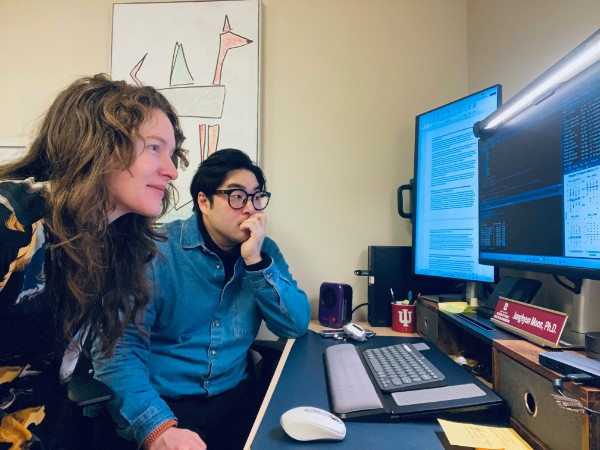
Thanks to a $425,000 grant from the National Science Foundation (NSF), Eise and postdoctoral fellow in the Department of Environmental and Occupational Health (EOH), Junghyun Moon, are currently conducting a vital climate change messaging research project entitled, “Retelling the Story: A Longitudinal Study Exploring How Tailored Moral, Ethical, and/or Spiritual Multimedia Narratives Influence Climate Change Mental Models.”
This study is part of a larger multi-year research project that kicked off with the Earth Connection Film Festival that was held at the Buskirk-Chumley Theatre on Earth Day in April 2024. Three films from that festival representing a specific storytelling approach—The Straight Poop for humor, Climate Creativity for education, and The River for sentiment will be shown to a sample size of 800 participants, and their reactions will be analyzed to compare effects.
“Our research project examines how different storytelling approaches influence the way people conceptually understand climate change,” says Moon. “Together, these films highlight different ways climate stories can inform our thinking, stir our emotions, and motivate our actions.”

Research has shown that restructuring mental models are an effective strategy for generating enduring change, according to Eise, and popular narratives in films or media can greatly influence how the public processes and responds to issues—such as climate change—that affect us all.
“There is space to advance mental models of climate change that are more supportive of environmental action that are informed and supported by scientific findings,” says Eise. “Environmental action is not political action. Any action we take that is pro-environmental is good for all of society as it creates a healthier world for us to live in and secures our future through sustainable natural resource access.”
A PhD graduate of The Media School at IU Bloomington, Moon jumped at the opportunity to work with Eise because of their common interests to better understand how people interpret and trust public information.
“[Eise’s] research brings together climate communication, the moral and ethical dimensions of how people make sense of climate change, and the power of storytelling to shape public understanding,” says Moon.
Moon plays a crucial role in this study, developing the audience survey and experimental measures, as well as analyzing any change over time of the mental models of the study participants. Being a part of this research project that involves a diverse set of climate narratives directly supports Moon’s career goals in the field of EOH as he can “extend this line of inquiry into a domain where communication plays a critical role in shaping both public perception and public health outcomes.”
Moon adds, “Participating in this NSF-funded project also strengthens my long-term goal of developing evidence-based communication strategies that help communities better navigate environmental challenges…it also lays important groundwork for future interdisciplinary collaborations and supports my commitment to connecting communication theory with practical, real-world environmental and public health needs.”
Stay tuned to SPH-B communications to learn more about the upcoming Earth Connection Film Festival that will be returning for Earth Day 2026!
Read more stories about SPH-B students, staff and faculty making a difference both locally and abroad here: go.iu.edu/48bx