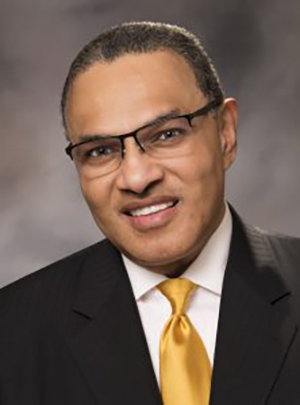
Description of the video:
For the next part here I would like to introduce Dean David Allison, who has been our dean for over three years now. It's a pleasure to have him with us and he's going to introduce Dr. Murray, who is then going to introduce Dr. Prothrow-Stith. So, Dean Allison? Thank you, Brandon. Well, it's a pleasure to be here today. And Brandon is correct that Dr. Murray, who might want to adjust her camera a little bit so she looks a little taller. It will be the formal introduction. But in the meantime, I'll just I will introduce Dr. Murray in a moment. But just informally say how grateful I am to have Dr. Prothrow-Stith with us. I've known her for years. She has been a great help to me and many others on many occasions. She has been a source of wisdom and support, and I'm grateful for that. One of the things that I'm most proud of and grateful for the opportunity to be a student here in the School of Public Health at Indiana University Bloomington. And that might seem initially like a slightly odd statement. Aren’t I the dean, aren’t I a professor. Yes, I am the dean. Yes, I’m a professor. But I'm first and foremost a student. And I think all scholars are first and foremost students. We never stop being students. And the great thing about being a student is to be able to learn forever and to be able to have great teachers. And I can imagine no greater teacher than Dr. Prothrow-Stith, and I'm grateful to have her here. And another great teacher is Dean Maresa Murray. Very lucky to have Dean Murray here. And I would like to introduce her now. She is an expert in some of the topics we're discussing. You see behind me the sign that says just science and the scales of justice and indicators of science. And I stole that from a podcast. And I periodically like to use this one because it reminds me that we should just focus on what we know on the basis of science. That it’s just. That science itself must be just in the way that we conduct it, and that science must aim towards justice. And Dr. Prothrow-Stith will discuss that; Dr. Murray has committed her own life and career to the pursuit of justice and well-being among many people, all people, so we’re lucky to have her here. She is a scholar of the highest order. Dr. Murray, the floor is yours. Good morning everyone. My name is Dr. Maresa Murray and I'm a clinical associate professor in the Department of Applied Health Science. I'm also the assistant dean of diversity, inclusion, and organizational climate for our School of Public Health here in Bloomington. Today I am honored to introduce our January colloquium speaker. Dean Deborah Pro I'm sorry, Prothrow-Stith. Dean Prothrow-Stith is dean and professor at the Charles R. Drew University College of Medicine in Los Angeles, California. She advised top-tier healthcare institutions in an area called leadership as a principle at Spencer Stuart, and also served as the Henry Pickering Professor of Public Health Practice. Additionally, she previously served as associate dean of diversity at the Harvard School of Public Health, where she actually created the division of public health practice and secured over $14 million in grant funding for public health programs. While working in inner-city Boston, she broke new ground in in redefining youth violence as a public health issue. She was the forerunner in the development of violence prevention curricula for schools. And one of the main pieces of curricula that she developed is called the Violence Prevention Curriculum for Adolescents. She has either authored or coauthored works such as Deadly Consequences; Murder is no Accident; Sugar and Spice and No Longer Nice; as well as a high school textbook that is very widely used called Health. In addition to those contributions, she has published well over 100 peer-reviewed publications. In 1987, Governor Michael Dukakis appointed her as the commissioner of public health for Massachusetts, where she led a department of over 3500 employees, eight hospitals, and a budget of over $350 million. Dr. Prothrow-Stith is a graduate of the Spelman College, a historically black college and university, and Harvard Medical School. And she's also a diplomat of the American Board Internal Medicine. In 2003, she was elected to the prestigious National Academy of Medicine. She has received ten honorary doctorates. And in 2017, she was named the Woman of the Year for the second district by the LA County Board of Supervisors. So without further ado, I want to thank you all for being here with us this afternoon and please join me in giving Dean Deborah Prothrow-Stith a very warm virtual SPH welcome. Thank you very much, Dr. Murray. I appreciate that introduction and it's a pleasure to be with you. Dr. Howell, thank you for this opportunity. And Dean Allison, I know that your commitment to being a lifelong learner is also shared. And one that, that I too find inspiring in my administrative role at the CDU College of Medicine, being able to remain a student while administering the work. Being a dean does remain a delight for me as well. Thank you for this honor and this opportunity. I am going to share some thoughts about the work to prevent violence in the United States, and I look forward to our opportunity to have Q and A. I'll start with just thinking about with you what it means to call violence a public health problem and why that came to be. I will share a little bit of history, if you will. For a long time. I was reviewing the 30 years of work in public health to look at violence prevention and discussing that in my talks and someone said to me, “Well, it's been about 10 years that you've been saying 30 years.” So now I realize it's about 40 years of work. So there will be a little bit of history in what I am sharing. Part of the realization in the early days of this, especially as we were reaching out to police and bumping heads with criminal justice, was, was just appreciating that what we as a society call upon the criminal justice community to do is really tertiary prevention. If you put on a public health lens or target it—we used to say primary, secondary, tertiary. Now we have universal and selected and targeted. And I really like what you see here, width, which some teenagers in Philadelphia offered us, which was upfront, in the thick, and after the fact. So what we ask criminal justice to do is pretty much after the fact, it's figure out what happened. Figure out who's to blame, execute punishment on behalf of society. And when this public health lens is applied to violence prevention. And when we did early on, we realize that what was really missing was the primary prevention and secondary prevention. So this chart just shows public health’s responsibility in this sort of gold color, which is mostly upfront, even though we do some after the fact, if you will. And criminal justice responsibility and white, which is mostly after the fact, but there is some upfront policing and more and more with community police reemerging as an item and police attention to relationships with the community that involve athletics with teenagers or going into schools in an educational way. There is some, some upfront policing. But all of this sort of came to be when Koop was surgeon general and many of us were beginning to learn what a big problem this issue of violence was for our patients. And I, as a medical student, was doing my third-year rotation in the emergency department when a young man, after my senior resident woke me up at three o'clock in the morning and told me to go put in stitches. A young man and I did. But I was a student. I was a third-year student, so I took a long time. I took about an hour. He had two stitches that are needed with the cut just over his eyebrow and that hour allowed me to talk to him and him to talk to me and he shared what had happened, that he had been to a party and danced with the young man's girlfriend, Another young man's girlfriend. They had gotten into an argument and friends and sort of egg this fight on and they finally got into a fight and he was cut. And then when I was done with the stitches, the senior resident said he was ready to go and he turned to us and said, look, don't go to bed because I'm going to go get this SOB who cut me and he's going to be back in this emergency room in about an hour. You're going to get all the practice you need putting in stitches. And he said it with this, you know, sort of bravado and humorously and we all kind of laughed and he laughed. But almost immediately, I started feeling inadequate and unsure why we had no response to what was a clear risk and how different that was for everything else that I learned to treat in the emergency room or anywhere anywhere else in the healthcare delivery system. I realize that had he made a suicide attempt and said I'm going to go home and take some more pills. And you're going to get all the practice you need cleaning out my stomach. We would have responded very differently. We had a protocol, we would have called the mental health workers, the psychiatric nurse. We might have even kept him against his will in the hospital. So almost immediately with that experience and my finding others in the country who were asking similar questions. We started making the case: You know, this is a, this is a public health problem. And we said it was because of the magnitude of the problem, because of the characteristics of the problem, which was very interesting to learn at that time. Because like most people, I thought that violence in America was all about some stranger bad guy that was coming from some other community and harming people. And I learned that a lot of the violence in the United States, whether we're talking assaults or homicides, has to do with friends and family and people who know each other and getting into an argument. And the more we learn, the more we realize that the after the fact strategies were not sufficient, that we did need to do some upfront around behavior. Well, my contact in the ER, it was another reason we realized almost immediately that whether it was oral surgeons or visiting nurses or dentists or primary care doctors, we were all having contact with both victims and perpetrators. Health care was having contact. And then we made a big assumption then which was late seventies, early eighties. And that was that some of the same things we had been doing for drunk driving, for teenage pregnancy prevention, for lead poisoning—Some of those same strategies, whether it had to do with public policy or changing behavior, ought be applied to this issue of violence prevention. And well, over time, we've learned that in fact, those strategies can help us. And we'll talk a little bit more about that. One of the things that, that really strikes me about our violence in the U.S. and our ability to respond to the problem is that we've had an impact (“we” being public health), and by public health I'm really thinking quite universal. I'm thinking about our interdisciplinary, comprehensive approach, policy-based and practice based approach to problems. But we've had some we've had some success with motor vehicle accidents and that's what you see in the, in the blue line here. Whereas the red line over time and that says from 1950 to 2015, it really is sort of over time. Look at this. We had to make the case that this was a health problem. And you know, what we have done in this country around death from crashes has made a difference. With firearms, we have been less successful. And, you know, the, the, the numbers from gun deaths and the numbers from car crashes are often very similar from place to place, but the amount of money that we spend on prevention and the policy-directed activity on prevention is very different. And I think that's part of the reason we haven't seen the impact on that red line, that we've seen on that on that blue line. Well, what have we learned over the last 30, 40 years of looking at this and encouraging epidemiologists to look at this and getting our public health practitioners in schools and communities to look at this. Well, we've learned some about the risk factors for violence in America. And certainly there are issues of poverty and income inequality. Something shown very clearly to correlate with homicide rates. Whether we're looking at states in the United States or the United States compared to other countries. Access to guns, another very important risk factor. We've learned that alcohol and other drug use; that witnessing violence, probably one of the more robust risk factors is witnessing and victimization and what some would call that cycle of violence. I put biologic or organic here because we know some things about serotonin and other neurotransmitters that don't—those things don't necessarily mean genetic, but certainly represent, I think the body's response to the environment. And just think about a fetal development in a situation where a woman has very high adrenaline rates and cortisol rates. And what that might do to the ability to make serotonin or receptors for serotonin. And so there's some learning that we can do there. One of the factors that I think a lot about is this issue of the culture of violence. And we'll talk some more about that. But let's talk about guns for a minute because that's one of the reasons the United States really stands out compared to other industrialized countries. And that was one of the biggest arguments we were making early on, that this was not some kind of genetic problem that we had in the United States. It was not some kind of inevitable part of our human condition here because other countries didn't have the problem that we had. And it's suggested strongly when we started comparing ourselves to other industrialized countries that we were doing, things that we shouldn't do. Or there were things that we should be doing that we're not doing or some combination, but that we were dealing with a preventable problem. And I I just have to say that I think that's probably one of the most important contributions that public health has made over the last four decades. Looking at this problem is to say it's preventable that there's something we can do about the problem. Because when we look at this issue of guns in America, one of the things that surprised us early on was that there were many more suicide, sometimes twice as many suicides as homicides every year in the United States. And that was really surprising because of what we see in the media and what we learn to fear and what we develop policies around. This this chart comes from the Gun Violence Archive and worth checking, you can from the National Institute of Justice and the Department of Justice get the Uniform Crime Reports. They tend to be 18 months to two years behind. So there are other data sources, but I find it very interesting that we don't appreciate when we talk about gun violence, some similarities that may exist between homicides and suicides, particularly with adolescents. If you think about the role of alcohol or other drugs. If you think about the role of guns, if you think about the role of precipitating instances or peer responsibilities for relationships and how they impact both in the homicide and suicide arena among teenagers. And if you think about adolescent development, all of a sudden, the demographics of homicide, which often are urban, Black and Brown young men in under-resourced communities and families experiencing poverty or suicides which tend to have a different demographic. It, it may be that there’s a lot more similarity from a cultural and risk factor in these two arenas. So gun violence is one of those areas that public health has addressed. And obviously we have come right up against conversations about the Second Amendment. I just put it here so we could read it and understand the problems with interpretation or the challenges. “A well regulated militia being necessary to the security of a free state, the right of the people to keep and bear arms shall not be infringed.” And those interpretations, you know, and, and we won't deal with, but the presence of guns in our homes and in our communities is part of the problem that we're dealing with. When we talk about violence in America. I want to spend a little bit of time on the culture of violence because quite honestly that for me is the risk factor that is most compelling when I think about it. And I say that because if we look at things like the emergence of women and girls in the use of violence. I think about it this way. We've been marketing and promoting violence to boys and young men for centuries. We've been doing the same with girls and young women for probably three, four decades now if you think about our entertainment media and, and the display and use of violence there, I think it really for us….as you start thinking about how to improve and prevent, improve health and prevent violence among adolescence…girls are, in some ways, no different from boys. But in the violence arena, they don't use guns as much as boys yet. And I put YET there very intentionally. So it's the presence of guns, but what it means to have a gun and who uses a gun and how a gun appears culturally. That I think we also have to factor into this. Another aspect of this is that we're often told that it's hurt children who hurt other children. Traditionally girls would hurt themselves when hurt: Run away, become prostitutes, start using drugs. It was a much more internalized expression of that hurt. I think with this marketing of violence to girls, we're getting some of that externalization that we've seen for a long time with boys. And you know, people say, well, what's better? Well, I think where we have to start is at the hurt children side of this equation and figure out how to stop hurting children, but also how to help children heal. And I think as a country and as a culture, this idea of healing through things like forgiveness, if you will, or helping others, or mental health strategies, community-based strategies. This notion of healing is one that we have to promote as we think about violence prevention. Probably one of the most surprising things that caused me to start focusing on this issue of culture was the learning I did about dueling in the United States. Something that I really didn’t know a lot about until I came across Fox Butterfield’s book: “All God’s Children: The Boskett Family.” And in there he documents the homicide rate from dueling in the mid-1800s in Edgefield, South Carolina as about 18 per 100 thousand, which at the time that I was learning, this was about the same rate we were experiencing in urban America in the middle of the late 80s, early 90s epidemic. And I, I thought, oh, what, what is this thing? Well, as it turns out, dueling was a practice in the United States, brought with the European settlements that became quite common. Gentlemen who were in some ways “dissed” or dishonored, had to respond and this placard to the public on the right side of this slide sort of illustrates that it was really an insult. It reads, the object of this placard is to inform the public that General Lee read has declined, giving to me an apology for the insult offered. And it goes on to say that he's bound to give this. And this was the first sort of posting before mediators or seconds started trying to get that apology and prevent a duel, maybe, but certainly organize a duel if one had to happen. Harriet Martineau, and I really appreciate her contribution to this as an author, wrote that “it's understood that in New Orleans, there were fought in 1834, more duels than there are days in the year: 15 in one Sunday morning; that in 1835, there were 102 duels fault in that city between the first of January and the end of April.” And this isn't….and she makes note that duels were organized activities. They were not arguments with an impulsive response to an argument and what might be a homicide. These were scheduled and planned and people went about the business of organizing. In fact, it is believed that ambulances have their history in doctors coming to duels or being asked to come to duels with their carriages to treat injured people or participants in the duel. So it's an interesting reflection on our history. And certainly if you saw Hamilton (if you didn't, it's worth seeing)…but the document on which Lin-Manuel use as the back ground for, for the, for the musical, actually documents that Alexander Hamilton wrote in his diary before his duel and his son was killed in a duel three years before. He was challenged to a duel by Aaron Burr. And the night before he wrote why he shouldn't and duel, which is that he loved his wife and children, that he was in debt and he didn't want to leave them with that debt. That he really didn't have any real ill will towards Erin bar, that it was illegal. So we're talking about lawmakers for, for sure. And that it was condemned by his religion, which was Christianity. Then he wrote why he had to duel and that I found most interesting, the first being a pressing necessity of necessity not to decline the call. And and that's just straight-up peer pressure. That's just, you know, I gotta do it because that's what everybody expects me to do. That it would cost him political support. That's sort of like my posse. You won't hang with me, won't stick with me, won't support me. And then essential to his more utilitarian is just essential to his usefulness. Well, that's a lot like if they're going to beat me up every day, if I don't beat him up, boy, if I don't scare them, if I don't shoot them….Interestingly, this history and the, the migration a bit of the demographics around violence to include girls and women, really makes me understand that it matters what we say to our children. It matters what we say as a culture. It matters how we're entertaining. And certainly the presence of guns or other instruments of violence have a role. But I think we do need to think and, and look clearly and closely at our behaviors and our culture if we want to get ahead of this. Speaking of culture. So recently we have been forced to think about policing in the United States and police as a culture. And I don't think we should do that without understanding a bit of history, particularly as it relates to police and the Black community. This is a placard that was posted in 1851. So before the end of slavery. And during a period where fugitive slaves were coming north. And you might've seen the movie 12 Years a Slave, which was about the recapture of a man, assuming that he was a fugitive. But going north and getting to places like Boston where you could live a free life…or even as far north as Canada, where Harriet Tubman settled…made a huge difference in your life. But in Boston in 1851, this was posted and basically it's a placard that says, Don't talk to the police because the mayor and alderman have enfranchised the police to kidnap and catch fugitive slaves. And they are saying, don't tell any police officer, anything like, Oh, you know, Miss Jones has a new boarder or I saw a new guy at the store. You know, those kinds of tips cause people to say, well, who's the new person and how did he get here? And so, you know, to the point of, I guess if it were social media, then you could imagine now it would be on Twitter or on Facebook saying, don't talk to the police. But what's interesting is 1851 sounds like a long time ago. And in some ways it is. You can imagine that someone’s, you know, great grandparents told somebody's grandparents, told somebody's parents, told somebody don't talk to the police. They are not, you know, they're not here to protect and serve us. And so with that background, I think America really does have to take a look at several aspects of policing. And this is, this is where I become confessional. I have to admit here because when I first started looking at this problem back in the mid-80s and getting the DOJ data from the Uniform Crime Reports, I was aware of what was called justifiable homicide. And when we graphed out the the homicide categories at the bottom…much, much lower than homicide among family or home inside, among friends or stranger violence, much, much lower…but steady, always there, was this this line at the bottom of the chart that was justifiable homicide. The definition was and is the killing of a felon by a police officer or a peace officer in the line of duty, and in the in the commission of a felony. So that that's the part that's in both of these definition. Even if it's a private citizen, it's the killing of a felon during the commission of a felony by a police officer or a private citizen. And, you know, I just assume, hey, you're committing a felony. Well, you know, I'm not going to spend my time trying to prevent that violence. I'm trying to prevent youth violence. The numbers up here at the top of the chart, not appreciating even though as a Black American, I knew many, many, many, many stories of police brutality, of police being unjust, of police arresting a friend's son who called them because he thought somebody was breaking in the house and even though he had his robe and house shoes on, they came to the house and arrested him. You know, I I knew those stories about the police, but but still, I assume that this was in fact what it was. And if we look at these numbers, what was on that prior chart was basically this light blue bar, which is law enforcement officers. But what's also here is this dark blue bar called the private citizens. So what we're looking at is, are from this is 2017 to 2019, but these numbers go back, that steady line goes back and I'm going, what we're looking at here is an endemic problem of homicides by police that we now know. And private citizens that we now know may not be so justifiable. And that's really a reflection of cameras and phones and other ways that people have been documenting this. And whether it's George Floyd or Breonna Taylor or Eric Garner. I mean, we've just been made aware that we have a problem, that all justifiable homicides are not justifiable. They may be labeled that way. But we, as a society have to look at endemic problem and begin to understand what it is that that we have created in our policing and what it is that we want from police, and how it is that we are going to interact with police through public health and other disciplines in order to truly prevent violence. And I'm just going to read that because I think it's really important for us to reflect upon as a culture. “First they came for the socialists and I did not speak out because I was not a socialist. Then they came for the trade unionists and I did not speak out because I was not a trade unionist. Then they came for the Jews and I did not speak out because I was not a Jew. Then they came for me and there was no one left to speak for me.” I think it's a very important way of thinking about what we know in public health is this notion of canaries in the coal mine. And I love that analogy for us as a, as a discipline, as we think about public health as a discipline. Because, you know, when the bird stops singing, when the canary stops singing in the, in the coal mine, then the miners knew something was wrong and they needed to get out, what they didn't do is start saying, Oh, something's wrong with this canary. Maybe this one's got a respiratory problem. Maybe we can get some little ventilators and put them on the canaries, you know, maybe we can, you know, have the canaries spread out. They didn't focus on what's wrong with the canary. They started focusing on what's wrong with the air. And let's get out of here before what's wrong with the air impacts us as well. And I think from a public health perspective, that's really important for us to sort of keep in mind that, that it is right to say, let's help hurt children heal. It is right to say, let's look at juvenile probation and juvenile detention and imprisonment as a way of talking about rehab and second chances. And, you know, let's talk about how to make a, you know, a situation that is clearly full of violence, less violent. That's right, that we should do. But we also need to appreciate what it is about us as a culture that creates this environment. Whether it's the, the injustice of poverty, which in and of itself is violence, whether it's issues of race and racism, whether it's the presence of guns, whether it's what we teach our children and how we're entertained or all of those things conflated. We have to think about these things and we've had some successes. So I'm going to talk a little bit now about what it is we have done and what it is we can do and how we are approaching it. Now as a problem. I think this is an important notion because there were quite a few late 80s, early 90s, very, very public visible shootings that led to the federal assault ban on semi-automatic and automatic firearms assault weapons signed by President Clinton. And it was a big day for those of us in violence prevention and in fact, was one of the first times the police joined with public health, to express support for a piece of legislation like this. And from that perspective, we had a success. But then just after that I'm sorry, let me go next to you. Just after that, we began to have a bit of a backlash. Now, whether this ban was effective in reducing the numbers of those sorts of things by length, homicides, mass shootings in particular, is certainly debatable. Some suggests that it did reduce the number of people per episode, which is what these the heights of these bars represent. So these, each bar represents a mass shooting in the years shown. And the height of the bar represents the number of deaths in that shooting. And as you can see, there is an argument that after the repeal, because that's what happened with the success we had the, the assault weapon ban was repealed or allowed to expire is, is another way Congress would frame it, but they allowed that ten-year ban to expire. And just after that, one can argue that the numbers of people killed in episodes continued to, to rise. We started experiencing a backlash only a couple of years later. And that is when the Dickey Amendment was passed. And that is when the, the Centers for Disease Control had $2.6 million taken out of its budget because there was a line item veto everywhere the word “firearm” appeared. And the backlash was in part because of the ban, but also what was precipitating and continuing, which was the data that was coming out. This particular article looked at the risk of having a gun in your home. There was a comparison of Vancouver and Seattle—Vancouver, British Columbia, and Seattle called a Tale of Two Cities. Public health epidemiologists were getting very involved and, and showing pretty clearly that guns do kill people. And those studies, along with the ban, created a backlash, which was the Dickey Amendment. And it basically stayed at night, passed in 1996. So two years after the assault weapon ban, it stated that none of the funds made available for injury prevention and control at the Centers for Disease Control and Prevention and may be used to advocate or promote gun control. And the implementation of that under the Bush administration became CDC doesn't do firearm data analysis or studies. Not to mention prevention. Despite that, some of the private foundations continue to fund the work. Some of the early heroes—Garen Wintemute, Art Kellermann who's cited in the prior slide—continue their work to a certain extent. But fortunately, we're now getting new data. And this particular study I found helpful in the way that secondhand smoke helped us with smoking prevention legislation. What we learned with this study of three thousand counties in the mainland U.S. so looking at the contiguous states is that generally, strong state firearm policies were associated with lower suicide rates regardless of the state's laws. Strong policies were associated with lower homicide rates and strong interstate policies were also associated with lower homicide rates where home state policies were permissive. And what that means—and the darker the blue, the stronger your firearm policies are—and the darker the red, the weaker they are. And the purple color is in between. But what is shown here is that the strong firearm work in California, for instance, has an impact on the states nearby. So even where home state policies were permissive, it was helpful to have strong interstate policies in the contiguous states. And finally, strengthening state firearm policies may prevent firearm suicide and homicide, with benefits that extend beyond state lines. So we're learning that things we've done, whether it's classroom education or or citywide programs like that in Boston or Minneapolis, or policies around firearms, that there are things we can do and there are ways that we can continue to address this problem. It seems—and we don't know, because we've had lower homicide rates nationally in the last I'd say half a decade, last five years or so we had a plateauing and then lower rates. And you've heard people talk about lower crime rates. But in the last year there appears to be a rise that I think we're going to call, we're going to be called to attend to. So public health people and physicians and visiting nurses across the country are really beginning to act on this issue. I think school shootings brought a lot of teenagers to the table. And what they did in Florida behind the school shooting there that of course made national news is, is noteworthy. And in fact, they were able to get Florida and I emphasize Florida. I'm saying Florida to pass a gun bill; it didn't do everything that one would want. But it did quite a bit and it was just striking that the legislature in Florida tended to this issue and passed a bill which the governor signed. Interestingly, right after the riot at the Capitol. One high school student tweeted, “So the members of congress had to duck under their desk and fear a shooting. I've had to do that six times during my high school years.” So it's interesting what young people can do for us. Pending now, introduced by Representative Karen Bass, is HR 7120. It will I think, be resubmitted in this, the 117th Congress if it hasn't already, but it lowers the criminal intent status such that the conviction of a law enforcement officer for misconduct is a bit more likely. It limits qualified immunity. And that's part of the immunity that has created difficulties in prosecuting law enforcement officers. It authorizes the Department of Justice to get involved at the police department level looking for patterns of discrimination; it creates a registry, one of the major ways that we learn about these these things. One of the contributions that I think was made in the effort around car crashes because it's basically the motor vehicle registry that allows us to understand a lot. You can figure out where car was painted, what kind of paint was used when there's a car crash, but we are still having trouble tracing the gun that was used when there's a homicide. So with the police, this is another way of understanding better what happens and when it happens. A framework to look at racial profiling and the new requirements around training and the use of data and wearing body cameras. So the assault weapon ban—Dianne Feinstein was the submitter of the bill back in ’94 and she's at it again and I think, you know—basically, we did it before; we can do it again. And I think we're in a position to really have those activities, school-based activities, city-based activities double and triple. So that we can just deal with this American problem, both the endemic aspects of it and the periodic epidemic that, that occurs as homicide rates wax and wane in the, in the country. So with that, I will end up and we can go for the Q and A. And thank you again for this for this opportunity. Wonderful. Thank you so much, Dean. We really appreciate that very informative presentation. I'd like to start with the question with Dr. Maresa Murray. And Dr. Murray, would you like to go ahead and I just wanted to announce to everyone: If you do have questions, please please let me know and we can start with that now. So Dr. Murray? Sure. Sure, that was absolutely spectacular, first of all, thank you so much. Such a wealth of information. And I just had a couple of quick ones. One was a comment in one was a question. One of the comments was in reflection on one of your slides where you mentioned that there's a need for healing, which is not often discussed in a public health setting. The idea of a need for healing around how we think of gun violence. And it's reflective of a conversation that was had with one of Dean Allison's—he has an advisory board called…well it’s called the Dean’s Alliance. With the Dean’s Alliance advisory board. Yeah. And her name is Marty Lemert and she is particularly concerned about gun violence. And she and I were talking about the rise of that was obviously happening in the last year of the rise of gun sales and ammunition among white Americans. And at the same time, there was a large increase of gun sales and ammunition buying among middle-class, middle- and upper-class Black Americans. And that was very alarming for people to see, and they were like, “What's going on?” Not necessarily with the white people, but the Black people not being lower class or those who are who people typically expect, but this other group. And so she and I were talking and she said something very reminiscent of what you said. She said Maresa, it seems to me that everyone's running out to buy guns. So I wonder if in the School of Public Health, I wonder if we don't have a gun problem, but maybe we have a trust problem. Because we're trying to “out-gun” each other and protect ourselves. And so maybe, a part of intervention in the School of Public Health could be, how do we build trust with one another? And I thought, “Wow.” So when you mentioned healing, that reminded me of it. Were you going to say something? I didn't want to interrupt you. No, no. Go ahead. I have several thoughts coming to my mind, but…Please share. Well, I think I do think that the issue of trust was one of the things that was eroded at the level of the citizenry and our government. And trust in CDC and science and trust in public service. And so there's a lot of work that has to be done there. And I think, you know, between ethnic groups in the United States, we've been through a period where the worst of us has been fed, you know….the parable about two wolves, it depends on which one you feed, whether you feed the wolf or the lamb or I'm messing it up, but you know what I'm saying, I think. So fear is a strategy of many, and because we are so deficient at healing and at solving problems, I would say we often wind up in a situation where we think the only thing to do is respond violently…if we are ever in that situation that we fear. I tell…I'm going to have a long answer to this one and I apologize. Awesome, so important. I tell the story of the first flight that I had to take after the World Trade Center, after the planes were flown into the World Trade Center. It was by about two weeks after that event that I had been invited six months prior to speak at, I believe it was Columbus, but definitely Ohio. And so I had a flight scheduled from Boston to Ohio and planes were flying again. And I had a conversation with myself and with my husband about flying. And I intellectually got myself on the plane. I thought, okay, you know, everybody's paying attention to security now; if you’re ever, in your whole life, going to fly again, this is the time to fly. You know, unless you're about to give up flying for the rest of your life. You know, it's as safe now as it ever will be again. So I got on the plane, my my mind was fine. I was on the plane literally. And there may four other people on the whole plane. And I—I broke down, I started crying, I started shaking….fear overcame me, and then I had this thought, which was: “OK, President Bush, you're supposed to be ‘the hawk.’ It’s been two weeks; you haven’t bombed anybody. I want these people dead. I want to be able to fly without having this fear and I don't understand why we haven't killed these people.” And then right after that was the thought, “Well, who the heck is this? Ms. Violence Prevention? I want to walk the walk. Like, I don't understand this.” Sure. And what I learned in that lesson, what was my real “a-ha” moment was that I really hadn't, despite our work in high schools to talk about conflict resolution and violence prevention, I hadn't dealt with fear the way it needed to be dealt with. Yes. And I do think that we've got to attend to issues of healing after trauma, of handling fear, of really being very intentional about helping people in situations where they were, or are, afraid. Fantastic. That was wonderful. Thank you. I yield. And that’s across race. It’s black, it’s white, it’s red, it’s yellow. We get afraid like that, there’s a part of us that needs a lot of help. Absolutely. Thank you so much. I'll yield my other question for other people. I think others are standing in line. Thank you, Dr. Murray. Dr. Jon Macy: You're up next, sir. Thanks, Brandon. And that was a really interesting talk. Thank you very much for taking the time to share all that great information with us. So my question is about your comments on culture. And it seems like there's a significant portion of our population who at this moment, are going to value individual rights, freedoms—and in this case, specifically the second amendment—over any public health or benefit that's going to come from gun control laws, regulations, policies, and things like that. And we can talk ‘til we're blue in the face, drive ourselves crazy presenting data on, you know, the jurisdictions with stronger gun control laws have fewer gun deaths and fewer homicides, fewer suicides. But people who really have these strong feelings about individual rights, second amendment, they, they get that but they just don't care. You know, the, the protection of individual rights and freedoms are more important to them than the public health benefit. And so I'm just curious about your thoughts about bridging that gap, if that makes sense. Yeah, no. And I think there are some there are some robust efforts to work in the space of control, not ban. And I think banning assault weapons just makes sense. I mean, you know, you can talk about it, but that aside, there are robust conversations about things we can do to make guns safer, treating them like automobiles. So, you know, there's a risk having automobiles on the street. But we say, if you're going to have one, you've gotta have two white lights in the front and you gotta have two red lights in the back. And those two red lights when you're putting on your brakes to get brighter. And you've gotta have a turn signal and it's gotta be inspected. And, you know, you can't have lead in your gas. I mean, so we have taken that industry which was dangerous and made it less dangerous and so with guns, there are people who are saying, let's use fingerprints as the trigger, so no body but the owner, which would probably help us with the one child a day, you know, that's killed in an unintentional situation with a gun. And, and that is, that is not something we should have to convince a lot of people about. The NRA is now bankrupt. And I think it was the obstacle to a lot of rational conversation about how do we have and keep guns if we decide as Americans that’s what we want, which we clearly have. But, you know, a little finger that, you know is, is much weaker than an adult's fingers should not be able to pull a trigger. So others have said, “Look, these hair triggers shouldn't exist; that the trigger should be something that only an adult can release.” We have irons that when we're ironing are close and we set the iron down, it shuts off. There's an argument for the same with guns. If you take the safety lock off and you were not using that gun, that in X period of time, the safety lock goes back on. So there are some middle of the road and, you know, there are some who would say, you know, if you're going to own a gun, you ought to be able to see, just like you can see….you have to prove you can see to get a driver's license. So I would say one of the things we can do is kinda work in that middle and work in the areas where there is more agreement than not. And, and most of the polls and most of the gun owners actually are very much in that middle. I think the NRA became kind of the voice saying, “You can't do anything because if you do anything, there’s going to be that slippery slope and then all of a sudden they are going to come get our guns.” There have been a couple of organizations actually, I don't remember the names of them, but it's worth googling if that's something you're thinking about. Because they are they are working on that middle area. Thank you. Thank goodness. The next is Dr. Jackie MacDonald Gibson. Dr. McDonald gets in there. Thank you so much for that. Just really, really inspiring talk. And I just wondered if you have any thoughts. I think, you know, so many people really truly believe that they're safer with the gun in their house than without, even though, you know, data show otherwise. Do you have any thoughts about how to really try to reach those people to kind of correct that misperception? I think we have to get back to producing those because there was an abrupt end to the Kellermann and the Wintemute work; Garen Wintemute is still working on issues here in California, but I think we just need to fund that work so that we understand the nuances better. There are good data, but they are old. And what's not in there is how people may or may not have defended themselves. That's a hard measure. So I would suggest that we continue that, but in the meantime—and directly related to being able to do that as well as public policy—is I think working with survivors of homicide. That for me was and it's the work I'm going to get back to doing. When I have “Dean-ing” time relief. I don't know when that’s gonna come. But survivors of homicides and serious episodes of violence—meaning mothers and fathers who have lost children to violence and siblings of those who were murdered—they tend to be, when given a platform, a very, very powerful source in, in influence, source of influence on public perceptions as well as public policy. So Tina Chéry in Boston is an example of a mother whose son was killed. Her son was killed. It's been maybe 25 years now. She started an institute in his name: the Louis D. Brown Institute. And she is active around public policy doing things that public health professionals and epidemiologists really aren't able to do. She has an ear that we don't have and being her partner and being a source of information and helping to create a platform is a strategy that can help with that. So I do think that those who have unfortunately experienced the tragedy of a suicide or a homicide with a gun in their homes may help us with this, may be influencers here. But we do need more data. We, we, we actually do because “A Tale of Two Cities” I think was published in ‘93, that Kellermann study that shows that you are four times more likely to have a suicide in the home and three times more likely to have a homicide knowing somebody. Homicide involving somebody you know, if there's a gun in the home, I think that's early nineties as well. So so we've got So I mean, that the ban that was put on CDC, that $2.6 million in 1996, those were 1996 dollars. So that had a huge impact on on the data and what we know and for all that we can't do in public health, what we can do and what we do well is create that database that will allow somebody like a Tina Chéry or other advocates and other survivors to really make the case publicly. Thank you very much. Thank you for your question. Next is Kourtney Byrd; she is a fourth-year doctoral candidate and associate instructor in the Department of Applied Health Science, Kourtney. And then we have then Dr. McCloskey. Thank you for that introduction and hello. Thank you for your presentation today. And I just want to say wow, I am so inspired, and thank you for your last comment about working with those who have those lived experiences; as well as being a partner with them. My dissertation will explore the relationship between Black, Hispanic, and biracial males who are exposed to community violence and look at their risky health behaviors in Lake County, Indiana, which is a really understudied area. We hear about violence in Chicago, but not necessarily in Indiana, particularly Lake County, which is next door to Chicago. So I’m really, really excited. And I'm just going to ask a few questions. You mentioned about fear and healing and so…my dissertation is going to focus on what are their coping strategies, following some of the research from Dr. Noni Gaylord-Harden which she's very known in the field for coping in Black males who are exposed to violence. And just thinking about, you mentioned fear and as we know, recently…his name was Dante Barksdale, he was recently killed in Baltimore from the Safe Streets. He was a Safe Streets worker with the Baltimore mayor. So, just thinking about this uphill battle that a lot of us will have in doing this work, wanting to partner with communities. How do we remain, I guess, fearless? Because if you're working with communities and you have to go to where they are, if you will…how do you stay true to this work and there is a risk that you also may lose your life and being a part of whether you're a researcher; whether you’re an advocate….I’m just curious do you have any tips? Well, first you've got to stay safe as best you can. And so I would in Boston when we were doing the violence prevention work that caused President Clinton and Janet Reno to come and show this dramatic decline in homicides. We had gone from over one youth homicide a month—of a child 16 or younger with a gun, a month—down to zero. And we had been at zero for a year or so when Clinton and Janet Reno came and all of that, I mean, you know, victory has a lot of handmaidens and so everybody was taking credit. And everybody actually deserved credit in that situation because we didn't say it was this program or that program of this program. We had preachers who were going out on the street corners at one, and two, and three o'clock in the morning. So I let them do that. I didn't. So when I say stay safe, you know, there are people who are, you know, living the experiences, who want to change things. And those are the partners for you. Those are the people who can really help you bring authentic solutions as well as be present in places. And it's not just preachers or teachers or, you know, businesses. People go in those communities and have those conversations with the young people on a regular basis. It's a young people themselves. Because, you know, one of the times we were in the classroom in Boston and I was asking people, well, how did they stay out of fights? What did they do? One kid said, “Look, I play football to stay out of a fight,” and I was like, “Okay, what does that mean?” Because of course I'm thinking that football, that's pretty violent…if you ask me. A public health worker. He said, “Because I leave school after everybody else. And if I run into somebody who's trying to say, ‘Come on, man, let's do this. Do that.’ I can say ‘No man, I'm so tired, I'm coming from practice’ and being tired is a legitimate excuse. They don't call me a coward or wimp if I do that.” So the young people could be huge partners of yours. I call it looking for Roses. In other words, looking for Rosa Parkses—the people who will refuse to give up their seat on the bus and be there and present. And and we need to help by providing that platform and providing the information and being that partner for them. But they're out there and you do need to stay safe. The only other comment I make to you is that it would be interesting if there's someone doing their dissertation on adolescent suicide in the same area, I don't know how you might identify them, but there are some parallels there that I think are worth exploring, especially when it comes to the hurt and the fear and the pain that accompany both of those. Thank you. And the guilt. There's big brothers and big sisters who felt that they should have protected younger brothers and younger sisters from things. Boys who feel they should have protected their mothers from the battleground, and not just boys. So, so there's some similarities in those things that were worth exploring. I know we've run over and there's one more and I'm here, so I'm pleased. But if you need to shut down Dr. Howell just let me know. Well, thank you, Dean. Would 1:30 be OK for you? Yeah. Yeah. That's good. Dr. McCloskey has a question and then we'll end with a final comments with Dean Allison. Okay. Thanks. You're on mute. Sorry. Yeah. Can you hear me now? We overlapped at Harvard. I know! It’s good to see you. Yeah, and it's wonderful to see you in Los Angeles, a great social laboratory in itself iconic city. But you know, I had a question about sort of the idea of regulations and controls, over guns. If we were to sort of try to implement better controls. Isn't it true that….so I studied domestic violence and they're always cases of domestic violence where there had been previous arrests for DV and the guy still had a gun and he killed his wife with that. So what, what do you think about that? About the sort of people get between the cracks? Um, what what what's what's behind the low enforcement rate of registering your gun; taking your gun away if you’ve had felony convictions or domestic violence. I would really encourage a conversation with Garen Wintemute who's been behind some of the LA laws and I forgot the name of the law; maybe it's the Red Flag law. Where families…and it's not just domestic violence situations, but family members can say to the police “I’m concerned about what's happening with person X” and have their gun taken away. That is something that Garen Wintemute has been actively involved in and the DV part of that has really been the precipitant of his thinking about that. Unfortunately, I don't know the details, but I would really encourage a conversation with him and maybe he's a good public health colloquium speaker to think about having. But we know, for instance, with drunk driving and with smoking even that the role of family, children who ask their parents to stop or, you know, wives, but spouses generally you take away the keys. In the case of drunk driving, we know that family can play a huge role in this. And I think that it's it's there at that Garen has gotten a lot of traction with the work that he's been doing. But I would think we'd we'd want to start there because there are, as you mentioned, a lot of cracks to fill. And what we don't have is basic gun control regulation. So so there's some I don't I don't want to call it low-hanging fruit because it's not easy. But, you know, there are some pedestrian stuff that we can do state-by-state and even federally. But after that, and in the case of Garen, because California has some very strong gun laws, he's gotten into some of the granular, more nuanced levels and they're having some success with this notion. And it includes parents who have an adolescent kid who is…..who were concerned about what that kid is about to do or the behavior of that kid. And I think we've got some some possibilities there. Right. You said…I think there have been a couple stories of the mass shooters where parents were concerned about the kids owning guns but couldn't didn't feel they could do anything about it. Right. Exactly. So it's an attempt to address that and back to the homicide/suicide piece. Both seem to have this giving of clues before the event. So we know with suicide, that people may say to others, “Oh, I won't be here for that,” or give some kind of clue. Well, with with the homicide, often it's an escalating event or a kid taking making choices that, that are worrisome if you're a parent or a teacher. And the school shooting in Florida that I showed in the slideshow is one where the kid was known, had been reported, expelled, suspended, that that whole nine yards and nobody ever got up under that hurt. There was a lot of hurt there as well. We've got we've got some opportunities that once we get to exploiting those opportunities that are right in front of us, I think we'll discover others. So hopefully, you know, a decade from now there'll be a much more robust answer to your question. That is good positive note. I want to thank Dr. Murray, Dr. Howell, Amy Oakley for organizing this. I'm pleased to see so many of you and especially so many students on the call. Grateful to have our students express their interest and their enthusiasm and their smarts. So good for you. One of my favorite songs is by a former ambassador of the United States named Greg, Greg Engle. And the song is called “A Simple Prayer.” And some of you may have heard me quote from it before. And in it he says, “Leave this world better than before.” And that is what I think we all aim to do. And yet I often feel myself, how do I do that? The world seems so big and I seem so small. Where's the path? We need a Virgil to show us the path. We need a Lao Tzu to show us the path. I think today we saw our Lao Tzu. And I feel that I have seen some of the path. And I'm grateful to have a guide. Dean Deborah Prothrow-Stith. Thank you. You are a good friend to the world, not just to me. Thank you for your time today. Thank you very much.